FN Freezer Repair
Sub-Zero Freezer Frosting Over Again: Reading the Defrost Circuit
Frost sheeting the back panel of a Sub-Zero freezer within days of clearing it is a defrost fault, not a door problem. How to read the circuit, what usually fails, and when the part is worth ordering.
- Filed
- Read
- 3 min
- Revised
- Bench
- Redmond, WA
- Job notes by
- Dean Halvorsen
- Role
- Refrigeration technician — sealed systems and airflow
- In the trade
- 19 years
- Card
- EPA 608 certified
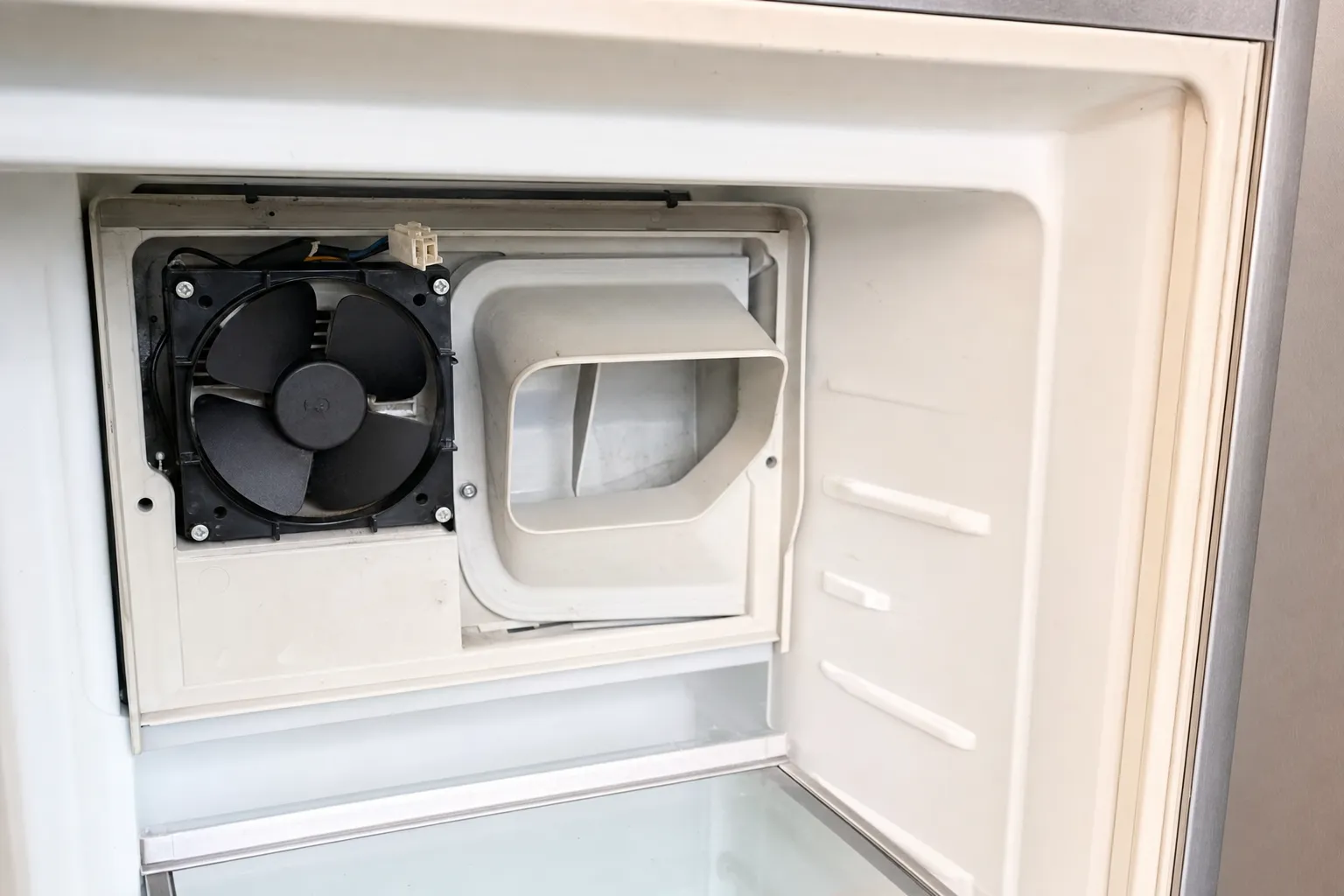
Frost back on the rear panel of the freezer a week or three after you cleared it is not a door problem. The melt half of the defrost cycle has stopped, and the evidence is behind the panel. Which part has gone depends partly on the series, because Sub-Zero built-ins have not all defrosted the same way.
Timer defrost against adaptive defrost
Every built-in freezer pulls moisture out of the air each time the door opens, and it lands as frost on the evaporator coil behind the rear panel. A heater melts that frost off at intervals, the water runs down to a pan in the machine compartment, and a terminator switches the heater off once the coil has warmed.
What decides when that happens is the part that changed between series.
On a 500 Series, Sub-Zero’s own use and care guide says the freezer section “is controlled by a timer which defrosts as needed.” The timer is a mechanical part with contacts that wear. A timer stuck in the cooling position means the heater is never called; a timer stuck in defrost leaves the freezer warming while the refrigerator side carries on.
On a 600 Series the timer is gone. The freezer runs on what Sub-Zero calls Adaptive Defrost, managed by the electronic control, which adjusts the interval to how the unit is used. There is no timer to fail, but there is a sensor on the evaporator that tells the control how cold the coil is, and a control that can record what went wrong.
On both, the refrigerator section defrosts during each off cycle of its compressor, so a frosted fresh-food coil points at airflow or the sensor rather than a heater.
What the later 600 Series will tell you
The later 600 Series control stores error codes that a technician reads from the keys in Diagnostic Mode. Three belong to the defrost circuit in Sub-Zero’s service table: EC 20 is under-heat with no feedback at the start of defrost, EC 21 is overheat, and EC 24 is plain under-heat. A stored code narrows the search to the heater, the terminator, the wiring between them, or the mounting of the evaporator sensor.
An earlier 600 Series unit, before serial number 1810000, stores none of that. It flashes SERVICE and leaves the rest to a meter.
The parts that fail, in the order we test them
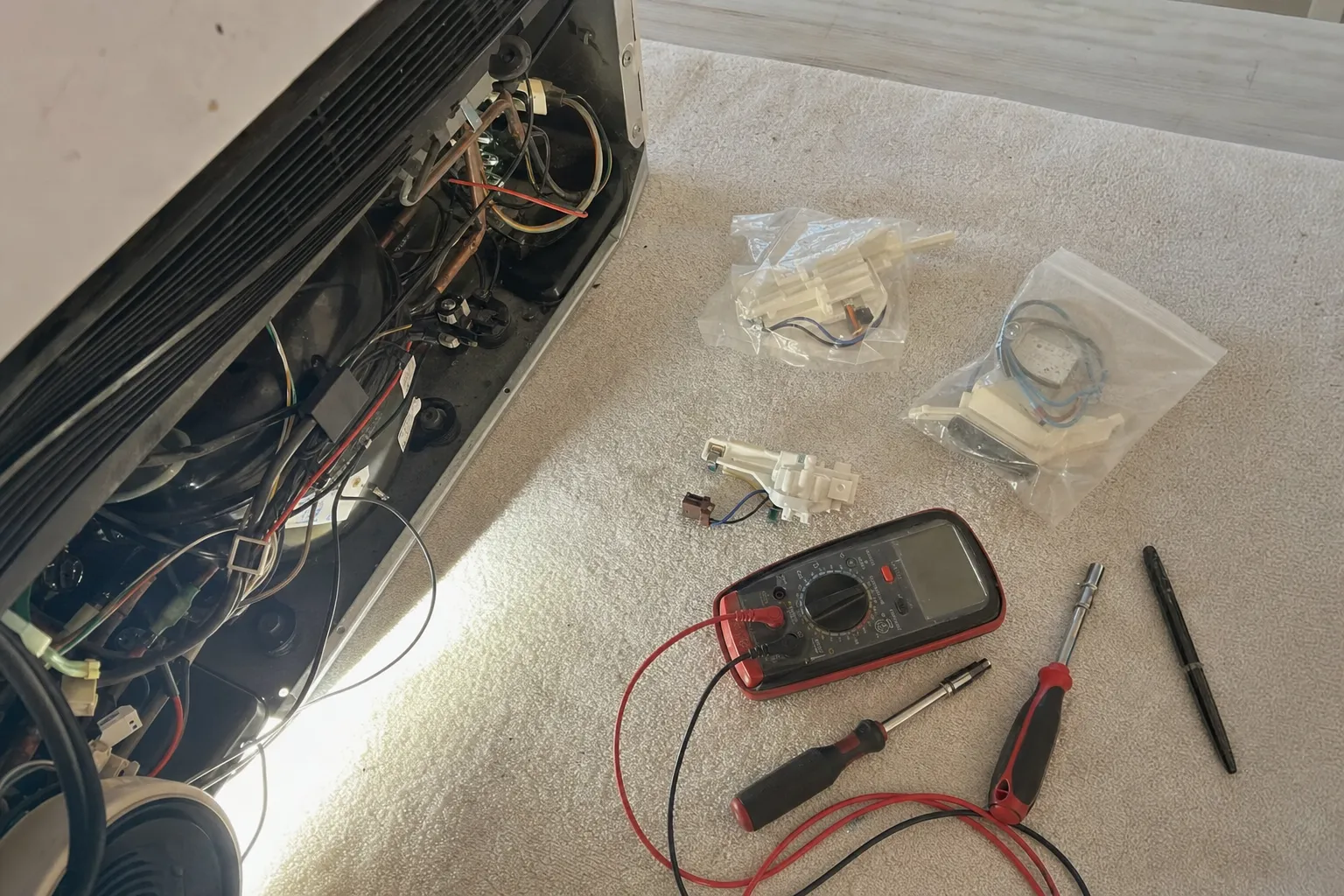
The heater. An open heater melts nothing. It is measured with a meter across its leads; an open circuit settles the question.
The terminator. It closes when the coil is cold and opens once the coil has warmed. Sub-Zero’s service manual for the later 600 Series gives 30°F to close and 55°F to open (70°F on the 601F-3, the later-control all-freezer, only). One that has failed open keeps the heater dead even while the control is calling for defrost, so it is tested cold, not at room temperature.
The evaporator sensor. If it reads warm, the control never starts a cycle; if it is badly mounted, the control can end one early. The same manual puts it at 30,000 to 33,000 ohms at 32°F.
The timer or the board. On a 500 Series the timer is a real suspect. On a 600 Series the control is last on the list and gets condemned only after the heater, terminator and sensor pass.
What you can check before anyone comes
- Where the frost sits. An even sheet across the rear panel points at defrost. Frost only at the door edge points at the seal or a door that is not closing.
- The door. Something on a shelf holding the door or drawer a fraction open feeds the coil wet air around the clock.
- The water under the drawer. Ice on the floor of the cabinet rather than on the coil means the melt water is not reaching the pan; that is a drain fault, not a heater.
Leave the coil itself alone. Chipping at ice on thin evaporator tubing can puncture it, and a punctured evaporator is sealed-system work with a far larger bill than any defrost part.
When it is not the defrost circuit
If the coil is clear, the compressor is running and the freezer still will not come down, the problem is in the sealed system, not the defrost parts. Frost only across part of the coil points the same way. Either way it is a diagnostic visit, and nobody should order a heater before a meter has been on it.
Asked after the visit
- Does a 500 Series freezer defrost the same way as a 600 Series?
- No. Sub-Zero's 500 Series guide puts the freezer on a timer that defrosts as needed, while the 600 Series uses Adaptive Defrost that adjusts to how the unit is used. Both defrost the refrigerator side during its off cycles. Sub-Zero Repair Redmond, (425) 905-2822, reads either kind.
- Why clear the frost if the part has failed anyway?
- Because a coil packed in ice hides the evidence. Once it is clear, a technician can start a defrost and watch whether the heater warms the coil and the terminator ends the cycle on time. Clearing it alone buys a few weeks, not a repair. Call Sub-Zero Repair Redmond on (425) 905-2822.
- Can the display tell me the defrost circuit has failed?
- On a later 600 Series it often can: the control stores defrost codes such as EC 20, EC 21 and EC 24, read from the keys in Diagnostic Mode. A 500 Series dial shows nothing, so the reading has to be taken at the coil. Sub-Zero Repair Redmond, (425) 905-2822.