FN Ice Maker Repair
Sub-Zero Ice Maker Stopped Producing: A Redmond Diagnostic Order
When a Sub-Zero ice maker quits, the module is rarely the fault. Work through supply, fill, freeze and harvest in that order and you will usually find the real cause before spending anything.
- Filed
- Read
- 3 min
- Revised
- Bench
- Redmond, WA
- Job notes by
- Dean Halvorsen
- Role
- Refrigeration technician — sealed systems and airflow
- In the trade
- 19 years
- Card
- EPA 608 certified
An ice maker that has stopped is one of the few Sub-Zero faults where the first guess and the actual cause rarely match. The ice maker gets blamed and replaced, and three weeks later the bin is still empty — because the ice maker was never the problem.
The reason is structural. Four things have to happen before a cube exists: water has to reach the valve, the valve has to fill the mold, the mold has to freeze, and the ice maker has to harvest. Any one failing gives the same empty bin, so you test in that order and stop at the first stage that fails.
Stage one: is water reaching the unit
Start upstream. A shut-off closed during a remodel or a plumbing job and never reopened is worth looking at rather than assuming. So is the water filter on units that have one: an overdue cartridge restricts flow enough that the valve cannot fill the mold in the time the control allows.
Pressure matters too, and the range depends on the series. Sub-Zero’s 600 Series installation guide asks for 20 to 100 psi at the valve; the Classic (BI) guide asks for 35 to 120 psi. A reverse osmosis system can sit below those figures once its tank runs down, and Sub-Zero does not recommend feeding the ice maker softened water at all.
Stage two: is the mold actually filling
With supply confirmed, the question is whether the valve opens. A fill valve is a solenoid. It fails two ways: the coil goes open and it never opens, or its inlet screen silts up and it passes a fraction of the water it should. The second is the confusing one — a few undersized cubes, then nothing, then a couple more.
Look in the mold. Ice in the mold that never leaves is a harvest problem. A dry mold with water confirmed at the unit is a fill problem. A thin shell of ice was filled short. Small or hollow cubes belong to the same family: a short fill freezes from the outside in.
Stage three: is the freezer cold enough
This one gets skipped constantly, and it is the cheapest to check. Put a thermometer in the freezer overnight. If the cabinet is warm, the ice maker is a symptom: chase the freezer instead — frost on the evaporator, a failing fan, a defrost circuit that has quit. Repair that and the ice usually comes back without anyone touching the ice maker.
On a 650 and other 600 Series units
The 600 Series gives you more to go on than most. Every built-in in that series except the all-refrigerators has an ICE key on the control panel, and the ICE indicator stays lit while the ice maker is switched on. If it is dark, the ice maker is simply off. Sub-Zero describes the cubes it makes as crescent-shaped; thin or hollow crescents point back to the fill.
When ICE and SERVICE flash together, Sub-Zero’s service manual says the control held the water valve open for longer than fifteen seconds. On the later 600 Series controls, five of those events are stored as EC 30, which a technician reads from the keys. The manual’s first checks are the same ones worth doing yourself: a cube jammed in the ice maker, an ice maker knocked out of level, and a fill cup pushed into the path of the ice. After that come the water pressure and the valve itself, which are a technician’s measurements.
A 650 keeps its ice maker in the freezer drawer below the refrigerator, so the drawer has to close fully for the freezer to hold temperature. A drawer riding on a stray bag of peas is a cold-cabinet problem before it is an ice problem.
Stage four: harvest, and when to call
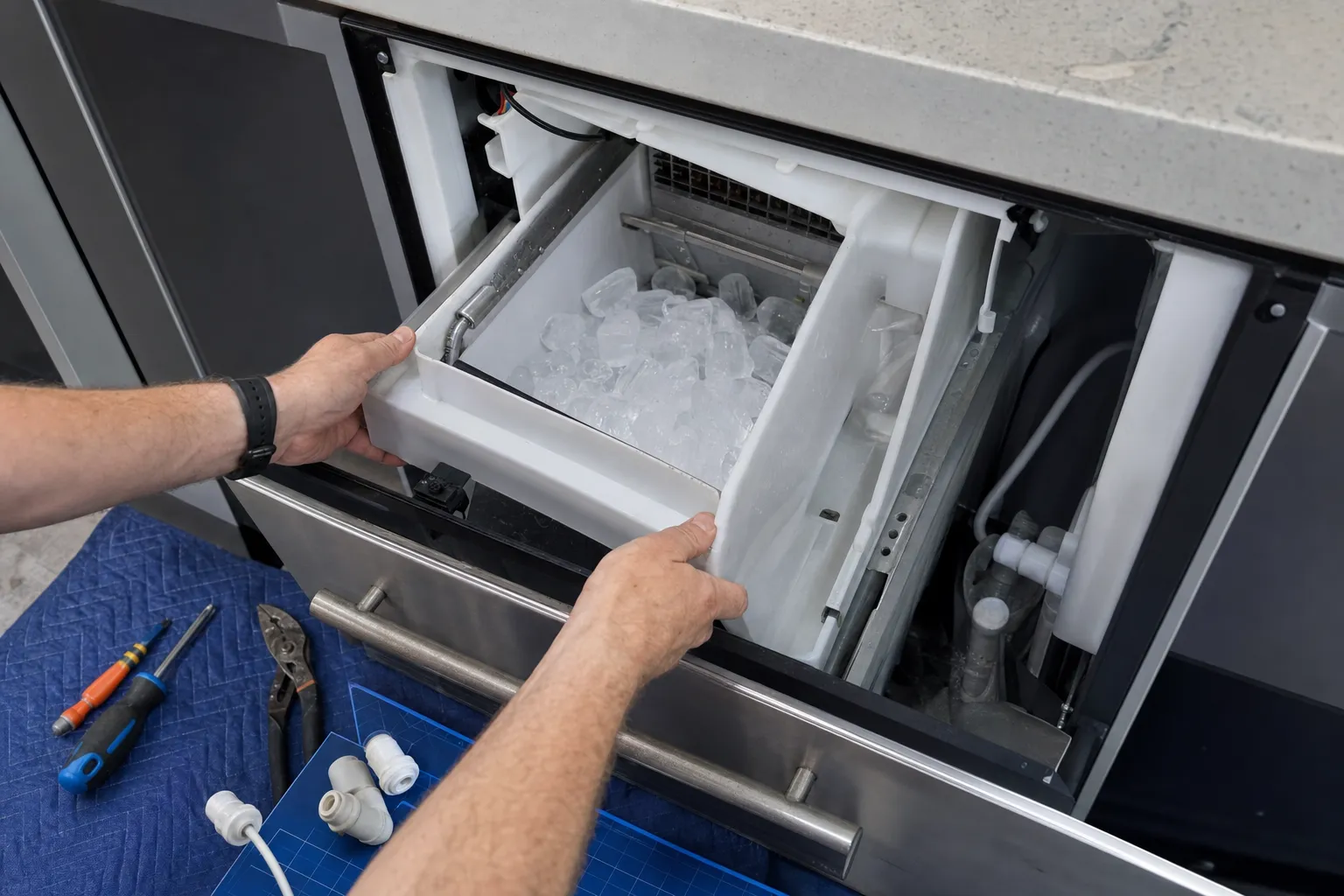
If water arrives, the mold fills and the freezer is cold, but the ice sits in the mold or fuses into one block, you are finally at the ice maker. A failed mold heater leaves ice locked in place; a failed motor leaves the mold full and the cycle stalled. Check first that the ice maker arm is down and moves freely — an arm resting on a pile of cubes stops production on purpose.
At that point it is a genuine part replacement, ordered against the model on the tag rather than on suspicion. What you should not accept is a quote for a new ice maker before anyone has confirmed that the water reaching it is right, because a new ice maker fed a short fill produces the same empty bin as the old one.
Asked after the visit
- How long should I wait after switching the ice maker back on?
- A full day. Sub-Zero's own troubleshooting for its Classic built-ins asks you to confirm the ice maker has been on for at least 24 hours and the freezer is near 0°F before calling it a fault. Judging it after one evening tells you nothing. Sub-Zero Repair Redmond, (425) 905-2822.
- My 650 shows ICE and SERVICE flashing together. What does that mean?
- On the 600 Series that pairing means the control held the fill valve open longer than fifteen seconds. A jammed cube, an ice maker out of level, a misplaced fill cup or low water pressure can cause it. Check the cube and the shut-off, then call Sub-Zero Repair Redmond on (425) 905-2822.
- Does the freezer temperature affect ice production?
- Yes. A freezer that has drifted warm makes ice slowly or stops, and the ice maker is often the first thing a household notices. Sub-Zero's troubleshooting asks for a freezer near 0°F before the ice maker is suspected. Sub-Zero Repair Redmond, (425) 905-2822, checks the cabinet first.